
1. Introduction to debt accounting
2. Financial statement recognition
- Initial measurement and recognition
- Short-term vs. long-term classification
- Subsequent measurement and amortization
- Accounting for debt modifications vs. extinguishments (ASC 470-50)
- Accounting for debt issuance costs (ASU 2015-03)
- Subsequent events & refinancing short-term debt (ASC 470-10-45)
- Convertible debt and debt with detachable warrants (ASC 470-20)
5. How FinQuery Debt Management helps businesses master ASC 470 compliance
6. Summary
Introduction to debt accounting
Debt is a sum one party is obligated to pay another party at a later date. Many different types of debt exist: money borrowed from a bank or other lending institution (such as a loan or note), and debt securities for sale to outside parties (such as bonds) are two common examples. These arrangements have various features and terms for repayment which affect how they are measured and reported on financial statements.
Topic ASC 470 provides guidance on accounting for debt for entities reporting under US GAAP. The standard consists of six core subtopics:
- ASC 470-10: Debt overall, addressing the determination of the classification of a debt arrangement
- ASC 470-20: Debt with conversion features and other options
- ASC 470-30: Mortgage loans
- ASC 470-40: Financing arrangements
- ASC 470-50: Modifications and extinguishments of debt
- ASC 470-60: Troubled debt restructurings by debtors
Financial statement recognition
Initial measurement and recognition
A debt transaction is recognized on the financial statements of an organization when an obligation officially exists. For the borrowing entity, debt is recorded on its settlement date, or the date the proceeds are received. The FASB requires transparency of obligations in reporting; from an audit perspective, completeness of debt account balances is the most relevant assertion.
To correctly measure what a company owes, multiple factors must be considered:
- Covenants and clauses: Some loans have special clauses or covenants that must be factored into the measurement.
- Interest rates: Interest may be charged in addition to the principal amount owed, or if no actual interest rate is stated, interest could be implied.
- Present value: As repayment is generally a future event, debt is often measured at its present value. For debt issued solely for cash, the present value is presumed to be equal to the cash proceeds received, which may differ from the principal value if the stated interest rate does not match the current market interest rate.
- Non-monetary issuances: When debt is exchanged for non-monetary assets, additional factors are evaluated to determine initial measurement, often discounting future cash outflows to factor in the time value of money.
Short-term vs. long-term classification
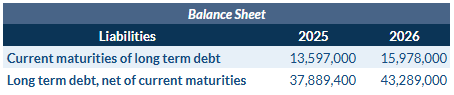
Debt is a liability, typically separated into short-term and long-term categories for financial reporting:
- Short-term debt: Represents debt due within the next 12 months. Short-term obligations finance day-to-day operations and are expected to be paid back quickly (e.g., lines of credit or bank overdrafts).
- Long-term debt: Represents debt due beyond the next 12 months. Organizations enter into these arrangements for larger purchases or strategic expansion. Long-term obligations typically carry a short-term current portion representing principal payments due within the next year.
Example of balance sheet presentation:
Subsequent measurement and amortization
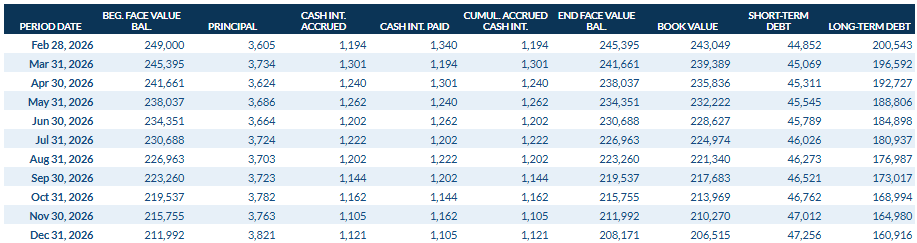
The liability initially recognized on the financial statements is reduced as payments are made:
- Loans: Generally require periodic payments covering both principal and interest.
- Bonds: Often, periodic payments may cover interest only, with the full principal carried on the balance sheet until maturity.
- Interest expense & accrued interest: Debt impacts the income statement as interest expense. Accrued interest ensures compliance with the accrual basis of accounting, recognizing costs in the correct periods.
Example of amortization schedule
Types of debt
Secured vs. unsecured debt
- Secured debt: Backed by pledged collateral (such as property, vehicles, equipment, or financial investments) that the lender can seize and sell if the borrower defaults.
- Unsecured debt: Not guaranteed by specific collateral. Lenders rely entirely on the borrowing organization’s overall creditworthiness and credit rating.
Notes payable and loans payable
A note payable represents debt arising from a formal promissory note or debt agreement detailing the amount borrowed, repayment term, and interest rate. Organizations utilize notes and loans to finance major asset purchases or boost operational capital without draining upfront cash reserves. Financial statements reflect the cash payments made, interest expense accrued, and liability amortization over time.
Bonds payable, discounts, and premiums
Issuing debt securities like bonds allows organizations to raise large amounts of capital at lower interest rates with fewer operational restrictions than traditional bank loans. Furthermore, bond interest payments can reduce corporate tax liabilities.
- Payment schedules: Issuers make periodic interest payments, while principal is paid at regular intervals or as a lump sum at maturity.
- Discounts and premiums: Because a bond’s stated interest rate often differs from current market rates at issuance, bonds are sold at a discount (below face value) or at a premium (above face value).
Advanced ASC 470 topics
Accounting for debt modifications vs. extinguishments (ASC 470-50)
When a company alters the terms of an existing debt agreement (such as negotiating a lower interest rate, extending maturity dates, or changing principal amounts), accounting teams must evaluate whether the change constitutes a modification or an extinguishment.
- The 10% cash flow test: Under ASC 470-50, a change in terms is treated as an extinguishment if the present value of the cash flows under the new terms is at least 10% different from the present value of the remaining cash flows under the old terms (using the original effective interest rate).
- Extinguishment treatment: If the 10% test is met (or if the change is substantial based on qualitative assessment), the old debt is derecognized, any unamortized debt issuance costs are written off immediately, and a gain or loss is recognized on the income statement alongside the setup of the new debt at fair value.
- Modification treatment: If the change is minor (fails the 10% test), the debt is modified prospectively. Unamortized costs are adjusted over the remaining life of the modified loan and no immediate gain or loss is recorded.
Accounting for debt issuance costs (ASU 2015-03)
Under FASB Accounting Standards Update (ASU) 2015-03, upfront costs associated with securing debt (such as underwriting fees, legal fees, and accounting costs) are no longer presented as a deferred charge asset on the balance sheet.
- Balance sheet presentation: Debt issuance costs are presented as a direct deduction from the carrying amount of the corresponding debt liability, matching the presentation of a debt discount. (Line-of-credit arrangements are an exception, where costs may still be presented as an asset and amortized over the term regardless of utilization).
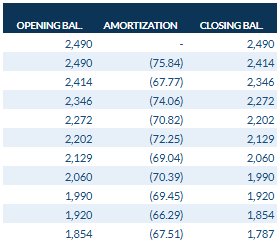
- Amortization: These costs are amortized over the life of the debt using the effective interest method and recognized as part of interest expense.
Example of debt issuance costs amortization
Subsequent events & refinancing short-term debt (ASC 470-10-45)
Organizations frequently face balance sheet classification questions when short-term debt is maturing shortly after the fiscal year-end.
- Reclassification criteria: To classify short-term obligations as long-term debt on the balance sheet, the entity must demonstrate both the intent and the ability to refinance the debt on a long-term basis.
- Demonstrating ability: Ability is proven if the entity actually refinances the short-term obligation on a long-term basis after the balance sheet date but before the financial statements are issued, or if they have entered into a non-cancellable financing agreement with a solvent lender that clearly extends past 12 months.
Convertible debt and debt with detachable warrants (ASC 470-20)
Complex capital structures often involve hybrid financial instruments, such as convertible debt or notes issued with stock purchase warrants.
- Separation models: Under US GAAP, detachable warrants require the separation of the debt host contract from the equity or conversion feature components.
- Measurement: Proceeds are allocated between the liability and equity components (or embedded features) to reflect the debt’s standalone borrowing rate, ensuring proper tracking of the equity conversion option and subsequent interest accretion over time.
How FinQuery Debt Management helps businesses master ASC 470 compliance
Managing complex debt schedules, tracking variable interest rates, recording modifications, and maintaining compliance under ASC 470 using manual spreadsheets introduces high risk for human error, missed covenants, and audit friction. FinQuery Debt Management automates and streamlines debt accounting so accounting teams can focus on strategic financial leadership:
- Automated debt schedules & amortization: Automatically generate centralized schedule calculations for complex debt instruments, including bond discounts/premiums, variable interest rates, and principal vs. interest splits.
- Seamless ASC 470 financial reporting: Effortlessly produce accurate short-term and long-term liability reclassifications, accrued interest entries, and footnote disclosures required for US GAAP compliance.
- Proactive debt covenant tracking: Set up real-time monitoring and automated alerts for key debt covenants, payment due dates, and reporting milestones to avoid default risks.
- Audit-ready traceability: Maintain a complete audit trail for all modifications, debt extinguishments, and restructuring transactions (under ASC 470-50/60) with single-click document attachments and roll-forward reports.
Summary
Debt is one of the primary methods companies use to raise capital. The most common forms of debt include promissory notes for large purchases, bank loans, and debt securities like bonds. Bank loans are frequently secured by pledged assets, while bonds provide large-scale borrowing with greater operational flexibility.
Because loans carry varying features, terms, covenant requirements, and complex modification rules, maintaining accurate financial records is critical. Comprehensive debt management ensures that financial statements fully reflect an organization’s financial commitments at any given point in time.