
In corporate accounting and financial reporting, debt financing structures require meticulous adherence to the core tenets of accrual accounting. Under United States Generally Accepted Accounting Principles (US GAAP), interest expense and its corresponding liability must be recognized in the period they are incurred, independent of the timing of actual cash disbursements. This article provides an analysis of the accounting mechanics governing accrued interest expense and accrued interest liabilities for standard commercial loan instruments.
Accrued interest liability vs. expense
The distinction between accrued interest expense and accrued interest liability represents a critical structural interface between the income statement and the balance sheet.
Accrued interest expense
Regulated primarily under FASB ASC 835 (Interest), interest expense represents the periodic economic cost of utilizing borrowed capital during a specific accounting window. Under US GAAP, interest is viewed as an expense that accrues continuously over time as the borrower benefits from the use of the funds. It reflects the systematic consumption of capital utility and must be recognized in the income statement of the period to which it relates.
Accrued interest liability (interest payable)
Governed broadly under FASB ASC 405 (Liabilities), this balance sheet account represents the present legal and constructive obligation owed to lenders for interest that has been incurred but not yet contractually disbursed as of the reporting date.
Under the accrual concept, interest obligations accumulate on a daily, non-stop basis. When an entity’s fiscal reporting cutoff (e.g., month-end, quarter-end, or year-end) falls between contractual interest payment dates, a formal adjusting journal entry is required. Failure to execute this adjustment results in a financial statement distortion:
- Understatement of Liabilities: The balance sheet fails to reflect the true leverage and short-term obligations of the enterprise, artificially inflating working capital metrics.
- Overstatement of Net Income: The income statement is insulated from the true operational cost of debt capital during that specific sub-period, misrepresenting the profitability and interest coverage ratios to investors and creditors.
Application and measurement mechanics
To ensure financial reporting precision, an entity must implement consistent mathematical methodologies to calculate the exact interest applicable to an accounting period. For a standard commercial loan utilizing simple interest, the measurement framework relies on a precise time-fraction formula:
Accrued Interest = Principal/Face Amount x Stated Annual Interest Rate x (Days accrued/days in year)
Day-count conventions
The specific denominator and numerator values utilized in the time-fraction are dictated by the underlying credit agreement’s day-count convention. In commercial transactions, two conventions predominate:
- 30/360 Basis: This method assumes every calendar month contains exactly 30 days and the financial year consists of 360 days. While historically favored for its computational simplicity in manual ledger environments, it is less common in modern bespoke corporate debt facilities.
- Actual/365 Basis: This method captures the exact number of calendar days elapsed in the numerator and utilizes a fixed 365-day year (or 366 in leap years) in the denominator. For precision-driven corporate lending and institutional credit facilities, the Actual/365 method is the industry standard to ensure exact economic reality is captured on the balance sheet.
Financial statement presentation
- Income Statement: Accrued interest expense must be segregated from operational costs. It is typically presented below Operating Income within a dedicated “Interest Expense” line item or under “Other Income and Expense.” This presentation preserves the clarity of operating margins while isolating financing costs.
- Balance Sheet: Accrued interest liability is classified under Current Liabilities (typically designated as “Interest Payable” or subsumed within Accrued Expenses). Because commercial debt contracts almost universally mandate interest payments at intervals less than 12 months, this obligation represents a short-term drain on liquid assets within the normal operating cycle.
- Statement of Cash Flows: The periodic recording of an interest accrual is a non-cash transactional adjustment; consequently, it has zero impact on the Statement of Cash Flows at the time of the adjusting entry. However, when the actual cash disbursement occurs, the entire cash outflow is categorized under Operating Activities under US GAAP, as codified in FASB ASC 230-10-45-17, unless the entity has elected a specific capitalization pathway under ASC 835-20.
Example: Accrued interest on debt
To illustrate, consider a corporate borrower that executes a commercial debt agreement under the following parameters:
- Principal (Face Value): $1,200,000
- Annual Stated Interest Rate: 6.00% (Simple, Non-Compounding Interest)
- Loan Origination Date: November 1, 2025
- Contractual Interest Payment Terms: Semi-annually in arrears every April 30 and October 31.
- Reporting Entity Fiscal Year-End: December 31
- Day-Count Convention: Actual/365 basis
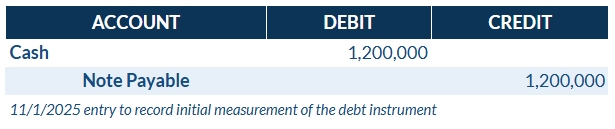
Loan origination (November 1, 2025)
Upon execution of the credit agreement and receipt of the loan from the financial institution, the borrower recognizes the cash asset and the corresponding long-term debt obligation.
To close the books for November, the accountant must recognize the interest expense incurred during the first 30 days of the loan (November 1 through November 30).
This is calculated as 1,200,000 x .06 x (30/365) = $5,917.81
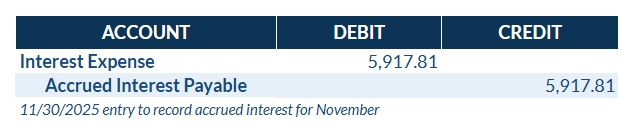
Financial Statement Status (as of 11/30/2025):
- Income Statement: Interest Expense of $5,917.81 reduces November’s Net Income.
- Balance Sheet: Accrued Interest Payable reflects a current liability balance of $5,917.81.
For the month of December, interest accumulates over 31 days (December 1 through December 31). The expense for this specific sub-period is calculated as:
1,200,000 x .06 x (31/365) = $6,115.07
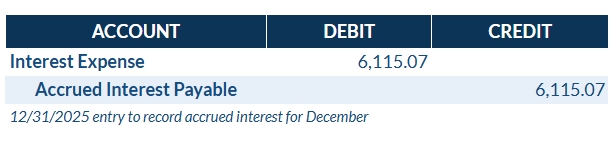
Financial Statement Status (as of 12/31/2025):
By breaking down the accruals by month, the cumulative balances automatically tie out to the total 61-day fiscal year-end obligation calculated previously:
- Total 2025 Interest Expense (Income Statement): $5,917.81 (November) + $6,115.07 (December) = $12,032.88
- Ending Accrued Interest Payable Balance (Balance Sheet): The credit balance in the liability ledger on December 31, 2025, stands at exactly $12,032.88, waiting to be partially extinguished when the contractual cash payment occurs on April 30, 2026.
Cash settlement and current-period recognition (April 30, 2026)
On April 30, 2026, the first semi-annual contractual interest payment is due. The total payment covers the entire six-month window from November 1, 2025, to April 30, 2026. The accountant calculates the total cash distribution based on the actual days in the full semi-annual period:
- November 2025 through December 2025: 61 days
- January 2026: 31 days
- February 2026: 28 days
- March 2026: 31 days
- April 2026: 30 days
Total Contractual Period Days: 181 days
The total cash liability to be paid to the lender is calculated as follows:
1,200,000 x .06 x (181/365) = $35,704.11
The accountant cannot charge the entire $35,704.11 cash payment to the 2026 income statement. Doing so would violate accrual principles by double-counting the 2025 portion or misallocating prior-period expenses into the current year. The 2026 interest expense must represent only the days elapsed within the current fiscal year (January 1 through April 30, 2026), which totals 120 days (31 + 28 + 31 + 30).
1,200,000 x .06 x (120/365) = $23,671.23.
Alternatively, the accountant would have made entries each month in 2026 similar to the entries above to recognize interest expense (combined for simplicity)
The entry is as follows:

Audit considerations and internal controls
For corporate financial preparers, accrued interest accounts are a frequent focal point during annual financial statement audits. External auditors systematically evaluate these balances to ensure there are no unrecorded liabilities. Key audit procedures and control frameworks typically encompass:
- Independent Recalculation: Auditors establish independent amortization and accrual schedules based on direct review of the underlying executed credit facilities, verifying the mathematical accuracy of client day-count parameters.
- Tie-In and Cutoff Testing: Reviewing subsequent cash disbursements (e.g., verifying the April 30, 2026 bank clearance in our example above) to confirm that the liabilities cleared match the exact provisions established on the balance sheet.
- Confirmation Procedures: Sending direct balance confirmation requests to institutional lenders to confirm principal outstanding, stated rates, and dates up to which interest has been paid.
Maintaining tight control over accrued interest expense and liabilities is essential for compliant reporting under US GAAP. Even on a straightforward commercial loan, calculating the exact cutoff dates and day counts is necessary to avoid misstating earnings and short-term debt obligations. Keeping precise, detailed schedules helps protect an organization from financial statement errors, ensures smooth quarterly closures, and provides clear visibility into cash obligations for senior leadership and stakeholders.