
Organizations that hold debt arrangements or instruments must disclose several key items about the debt outstanding so financial statement users can clearly understand what the organization owes and is obligated to repay.
These areas include short-term and long-term presentation, characteristics of debt, covenants, and other specifics tied to an organization’s portfolio.
Short-term vs long-term debt
One of the most important disclosure items for debt outstanding is the classification between short-term and long-term debt. Short-term debt is the portion of the obligation likely to be paid within the next 12 months, also referred to as the current portion. Long-term debt is the portion due beyond the next 12 months. This is also referred to as the non-current portion.
This classification appears in several places across a company’s financial statements and footnotes. The first is the balance sheet, where the current and long-term portions each receive their own line item to make the split clear:

Beyond the typical short-term versus long-term split, certain scenarios can move a balance from one category to the other. Several of these are outlined below:
- Intent and ability exception: Short-term obligations can be classified as non-current if the entity intends to refinance them on a long-term basis and has demonstrated the ability to do so. One such example is through a financing agreement signed after the balance sheet date.
- Subjective acceleration clauses (SAC): These clauses allow the lender to accelerate payment if a material adverse change occurs. If a trigger is probable, the debt must be reclassified as current. Whereas if the likelihood is remote, the balance can remain non-current.
- Lock-box arrangements: When a lender sweeps a lock-box daily to pay down a revolving line of credit (a hard lock-box), the debt must be classified as current, regardless of the stated maturity date.
- Covenant violations: If a financial covenant (e.g., debt-to-equity or DSCR) is violated at the balance sheet date, the debt becomes callable and must be reclassified from non-current to current.
- Waiver Rule: Debt can remain non-current only if the lender provides a formal waiver extending beyond 12 months from the balance sheet date.
Maturity schedule
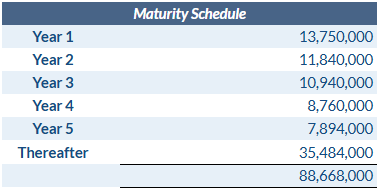
One schedule required in debt footnotes is the maturity schedule of debt outstanding, which shows when the debt must be repaid. It is commonly broken into annual buckets for years one through five, with the remainder allocated to a “thereafter” bucket. See the example below:
Characteristics of debt
Most organizations must also disclose the characteristics of their debt, including basic details such as the total amount outstanding at year end and the interest rate applied. These details are often presented in groups of instruments that share similar characteristics, or individually for each instrument outstanding at year end.
Financial covenants and the components used to compute them must also be disclosed, along with any breaches and their effect on the maturity of the affected obligations. Variable rates tied to an index must be disclosed as well, including the average rate for the instrument during the financial reporting period.
The final area to note covers modifications and extinguishments, along with the nature of each. Depending on the organization’s reporting requirements, debt issuance costs and unamortized premiums may also be presented in the footnotes. Additional case-specific disclosures — such as those for the fair value of debt and related party debt — vary with the nature of the instrument.
Summary
When preparing debt disclosures, the primary requirement is short-term versus long-term presentation. Beyond these two maturity categories, organizations must also disclose the characteristics of their debt and any specific circumstances a financial statement user would need to consider.