
Manual document management is one of the least fulfilling parts of any accountant or finance professional’s job. From the moment you get a document and abstract the data you need from it to the fire drill 6 months later when you need to find it because it’s one of the documents your auditor wants to sample – it’s a huge time-sink. Even for very organized teams, spreadsheets and shared drives just can’t eliminate all the headaches of document management. It’s a hidden bottleneck that slows everything down and can open your organization up to significant costs and compliance risks.
The costly reality of decentralized documents
Decentralized documents—characterized by scattered files, shared drives, and outdated spreadsheets—create a pervasive drain on resources.
The productivity drain
The massive time-sink of decentralized document management is a widespread issue. Studies indicate that the average knowledge worker spends about 1.8 hours per day on document-related tasks. That’s a lot of time consumed by activities that are ripe for automation.
When scaled across an entire finance team, these individual losses compound rapidly, creating significant hidden costs. A finance department with ten such professionals could, for instance, face a significant annual productivity drain from document-related inefficiencies alone. This extends beyond direct labor costs, leading to delays in crucial processes like approvals and other critical operations, which in turn inflate overall overhead expenses.
The impact of these inefficiencies also extends to human capital. Inefficient document management directly contributes to decreased employee morale and increased disengagement. When finance professionals are repeatedly frustrated by misplaced files or bogged down by redundant manual tasks, their productivity suffers, and their motivation wanes.
The high price of human error
Manual data entry is susceptible to human error. Even a seemingly low 1% error rate can add up when handling many documents and without a verification layer, the error rate can climb as high as 4%. In stark contrast, automated data entry systems boast accuracy rates of 99.959% to 99.99%.
This translates to a significant difference: for every 10,000 data entries, automated systems typically make between 1 and 4 errors, whereas human operators might commit between 100 and 400. This makes humans approximately 100 times more prone to data entry mistakes than automated systems.
Even small errors can trigger a ripple effect throughout the entire financial ecosystem, impacting critical functions from budgeting and forecasting to revenue recognition and tax compliance. These errors trigger downstream costs of decisions made on incorrect data.
Audit nightmares and compliance headaches
A decentralized system creates challenges during audits. The scattered nature of documents makes it extraordinarily difficult and time-consuming to locate every amendment, associated invoice, and supporting record. This often necessitates additional staff hours during audit periods finding misplaced documents to fulfill auditor requests. This can delay an audit and even lead to increased audit fees.
The centralized advantage: Building an audit-ready foundation
Centralizing documents and automating workflows directly translates into substantial efficiency gains and significant cost reductions across various financial processes. Companies implementing intelligent document processing solutions typically realize cost reductions within the first year.
The power of technology in centralizing documents
Modern software provides a powerful solution to the challenges of decentralized documents. Technology automates the tasks that once consumed valuable time and were prone to human error, creating a streamlined, efficient, and audit-ready workflow.
Improved accuracy
While human accuracy in manual processing ranges from 96% to 99%, often dropping with fatigue or high-volume processing, automated document processing consistently achieves accuracy rates of 99.959% to 99.99%. Solutions like FinQuery, enable teams to automate document abstraction, accelerating data entry and eliminating human errors simultaneously.
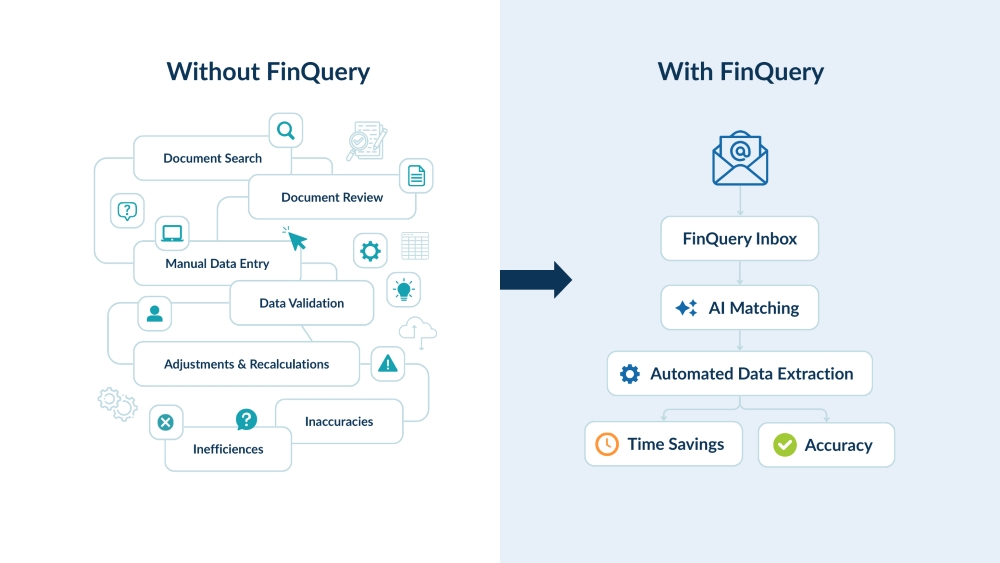
Simply forward your leases, contracts, or invoices from your inbox directly to a dedicated FinQuery address. The proprietary AI then intelligently processes the document, extracts key data, and pre-populates fields, matching them to existing records or seamlessly extracting crucial data to build new entries and providing a ready-to-review draft. It automatically links supporting documentation—such as amendments and invoices—to the correct primary record, eliminating the need to manually search for and attach files.
An audit-ready approach
An automated and centralized repository simplifies compliance by providing clear, built-in audit trails and direct links from financial entries back to source documents. Instead of scrambling to gather documents and reconstruct an audit trail only when a request arrives, an automated system ensures that an organization is continuously prepared. This proactive stance not only helps reduce audit fees but fundamentally transforms the finance team’s relationship with compliance, establishing it as an ongoing operational standard rather than a burdensome periodic event.
Less stress, more motivation for financial analysis
When finance professionals are freed from data entry and document hunting, they become more engaged and productive, eager to focus on higher-value activities that contribute to broader company goals. This positive shift in work focus not only boosts team morale but also makes it easier to attract and retain top talent, as roles become more strategic and less clerical.
Built to scale
As document volume increases, automation enables teams to scale operations without proportionally increasing headcount. This means growing organizations can handle increased operational demands without a proportional increase in labor costs, presenting a significant competitive advantage that directly impacts profitability and market share.
Summary
The shift from decentralized document management to a centralized, automated approach is not just a best practice—it’s a strategic imperative for modern accounting and finance teams. By embracing centralization, particularly through intelligent automation, organizations can dramatically improve accuracy, simplify compliance, boost employee morale, and build a scalable foundation for growth.
FinQuery empowers accounting and finance professionals to move beyond the time-consuming tasks of manual data entry and document hunting.